Life in France isn’t perfect—no place is—but there are some genuine upsides that have made my life a lot less stressful. I don’t sugarcoat things around here or paint France as some kind of utopia (spoiler: it’s not), but let me give credit where it’s due. Here are six things I stopped worrying about after moving to France—and honestly, it’s been a breath of fresh air.
6 Things I stopped worrying about after moving to France

I never used to be much of a worrier. I still probably only average a 5 or so on a worry scale of 1 to 10, but let me tell you, back in the day I rarely Worried with a capital W. Sure, things would stress me out but nothing gave me major cause for concern. I was maybe a 3 out of 10 across the board.
But as we get older and experience life, things can get hard. I’m glad no one told me that or it would have ruined my 20s. Life is tough and for me personally, family members’ cancer diagnoses, grief, and death have been the toughest for me the past couple of years. I think I live with more worry these days than I did a decade or two ago.
P.S.: Please, if it gets worse as we get older, don’t tell me!
If we turn to living abroad, there’s a lot of stress, worry, and doubt that comes with such a huge life change. But once we work through all of that, there’s a lot France has going for it. That’s not to say that the French way of life is all sunshine and rainbows, but there are a lot of things that have been pleasant surprises.
Here are 6 things I stopped worrying about after moving to France:

1. Random strangers carrying guns
Let’s kick this off with a big one. In the U.S., especially Florida (which is where I spend the most time stateside since it’s where my family lives), I always have this low-level unease about the fact that just about anyone on the street might be carrying a firearm.
Concealed carry is legal in Florida.

I snapped a photo of this sign at Neiman Marcus in S. Florida over the holidays.
A trip to the mall, a walk in the park, or a nice dinner out are all fair game. Guns are so prevalent that stores, which are private property, will have signs that remind customers that guns aren’t permitted on the premises. You’d never see that in France for obvious reasons.
People can be hotheaded and who knows what someone might do in a confrontation or case of road rage… and don’t even get me started about accidents where the gun goes off unintentionally.
In France, gun laws are very different and more regulated with no open/concealed carry (although hunting is legal). There’s no “culture” around firearms either.
Sure, France has its own issues, but the chances of someone randomly packing heat at the grocery store are slim to none. Gun ownership is long process and requires a background check, range practice, and you aren’t allowed to carry the weapon on you (unlike some US states where you don’t even need a license, registration or even a permit to buy a weapon), and you’re unlikely to encounter anyone with a firearm unless they’re hunting—or in law enforcement.
The result? For me personally, it’s a sense of relief.
Walking through a crowded outdoor market or taking public transportation here feels significantly safer, and that’s not something I take for granted. In France, it’s just…not a thing. Guns aren’t part of daily civilian life, and you don’t hear about shootings nearly as often.
The absence of that constant anxiety about guns is palpable for me. A story I never told here was when my dad and I were on a road trip and stayed overnight at a hotel in North Carolina off 95. At 6am, I thought construction was starting early but it was semiautomatic weapon fire right outside our window in the parking lot. It was apparently gang related and a man was killed.
Anyway, yes, there’s crime here in France too, including terrorist attacks. Criminals sadly exist everywhere. People can obtain weapons illegally in France too. Overall though, I feel safer here.
Also, I know some of you reading this might own firearms and feel differently than I do and that’s your right. I think we should all be able to live somewhere that allows us to feel safe, so to each his/her/their own.
2. The expectation to constantly be positive and friendly
If you’re American, you know what I mean. There’s this cultural expectation that you have to be cheerful and engaging all the time. Smiling at strangers, making small talk, asking “How are you?” even when you don’t actually want an answer. No one likes a complainer!
But France is not like that at all. In fact, complaining in France is a bit of a national sport.
At first, I thought French people were kind of cold. But they’re not rude; they’re just more reserved. There’s no fake enthusiasm, no forced pleasantries. Friendships here take longer to build, but when they do, they feel genuine. Conversations are real, not just social scripts we all follow out of habit.
And honestly? It’s refreshing. I no longer feel the pressure to always be “on.” If I’m having a bad day, I don’t have to pretend I’m great just to keep up appearances. It’s okay to just be.
Now that said, you might find some overly smiley, enthusiastic French people. They exist. Not everyone is a big complainer but there are definitely cultural differences at play and you won’t be told to SMILE just because. Amen!
Also, for the record, I think I’m a friendly person who at this stage of my life. I try to be pretty positive and see the bright side and am truly grateful through it all. But I DESPISE toxic positivity and putting on an air of fake happiness all the time just to be palatable to others and appear pleasant. That’s not a problem in France!
P.S. The French are VERY socially polite.

Photo credit: Shutterstock.com / Phovoir
3. Healthcare bankrupting me
Let’s talk healthcare. In the U.S., it’s a constant source of anxiety. Even with insurance, I’d worry about deductibles, co-pays, and surprise bills because you never knew if your insurance would pay and how much. A simple doctor’s visit could feel like a financial gamble.
Case in point: Back in the day, I had great insurance working for a big company and had allergy testing done. The doctor sent it to a lab that wasn’t in my network. I had no control over where my lab work was sent and didn’t even realize it was a question I needed to ask. But I learned right away to the tune of $1800 that insurance costs can catch you by surprise… even with great coverage.
In France, healthcare is a human right, not a privilege or a perk of working for a good employer. It’s not free—you and your employer pay into the system—but it’s affordable and accessible. A visit to the doctor costs about €30, and serious illnesses and emergencies don’t cost a fortune so there’s no reason to delay seeking out medical care if you’re unwell.
Better yet, prices are clearly displayed on the wall in the waiting room so you know the price ahead of time. The prices and reimbursements are the same for everyone (supplementary insurance, une mutuelle, is an additional cost though). Prescriptions don’t cost a fortune.
Behind the scenes at a French pharmacy >>
If something serious happens, I know I won’t be drowning in debt for the rest of my life. The system isn’t perfect, but there’s an underlying sense of security that I’d never had before.
4. Over-the-top tipping
Or rather, the fact that it’s barely a thing in France. I wrote all about tipping in France here and you do NOT tip 15-20% at restaurants.
Back in the states, tipping feels like a constant math quiz. Did I leave enough? Was it too much? Was the tip automatically included? It’s stressful.
In France, service workers actually earn a livable wage and while it’s not a well-paid job, it is minimum wage or above and they don’t depend on tips to make a living. Tipping is more of a “rounding up” situation or leaving a couple of euros for great service.
And you know what? The servers still get the job done and I no longer have to overthink every restaurant bill.
Since I moved to France, tipping seems to be gaining momentum, though. You’ll sometimes see the option on credit card payment machines to leave a tip, but it’s not required and isn’t seen as a faux pas to NOT leave a tip at the hair or nail salon or for your server.
Sometimes in touristy areas, you’ll get a very forward waiter who rudely asks for a tip, know it’s commonplace in the U.S., but that’s not the norm. Culturally, tipping hasn’t caught on here across the board and that’s a good thing IMHO.
7 Things France does better than the U.S. >>

5. The pressure to be productive
In the U.S., your career often feels like the ultimate measure of your worth. Long hours, trying to get that promotion, and always being available are badges of honor in many workplaces. Resting or having a personal life can feel like slacking off. Don’t even get me started on how that ties in to job security, since most jobs are at-will and don’t even have a contract.
In France, the work-life balance is sacred. It’s not just a cliché about long lunches and five weeks of vacation—it’s a fundamental part of the culture. All of this reflects a broader belief that life is about more than work and that we work to live, not the other way around.
One of the biggest mindset shifts I’ve experienced since moving to France is this: Your value as a person is not measured by how much you work.
In the U.S., working yourself to the bone is almost a badge of honor. Being “busy” is equated with being important. Taking time off? Often seen as laziness. Even vacations come with guilt—how many times have we heard someone say, “I really need a break, but work is just too crazy right now!”
In France, rest is not something you “earn”—it’s something you’re entitled to. People take their vacations seriously. A work-life balance actually exists. Even in high-pressure jobs, there’s an understanding that life comes first.
I’ve unlearned the idea that my productivity defines my value, and I can’t even begin to describe how freeing that is.
Work-life balance is respected here in a way that feels…refreshing. When I first got here, I was shocked that stores would close early or on Sundays. Now, I love that people prioritize their personal lives over being constantly “on.”
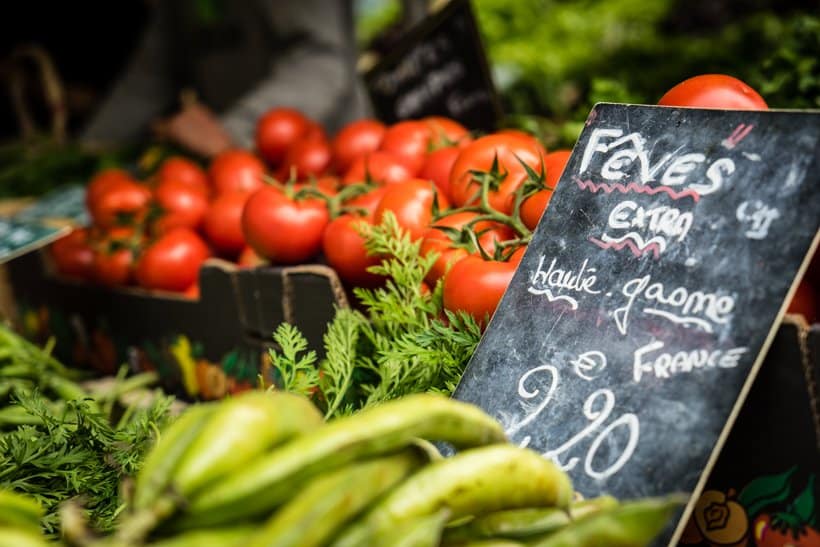
French food market with tomatoes, herbs, beans, and chalkboard sign
6. Food quality and the unhealthy additives that are commonplace in the U.S.
In the U.S., ultra-processed foods are everywhere. Even seemingly simple items like bread, ice cream, and yogurt can contain a long list of preservatives, artificial colors and flavors, and additives—many of which are banned in other countries, including France. The U.S. allows the use of additives like rBGH or rBST (a genetically modified growth hormone) in dairy, brominated vegetable oil (BVO) in sodas, and certain artificial dyes that have been linked to health concerns.
To contrast that with France, the EU as a whole has much stricter regulations on what can and cannot be used in food products. To give you an example, BVO in sodas which I mentioned above was banned in all of the EU in 2008.
Beyond just avoiding harmful additives, food in France is generally fresher. Supermarkets have shorter shelf lives on dairy and baked goods because they don’t rely on the same level of chemical preservatives. Farmers’ markets nationwide, even in small towns, are everywhere and ingrained in the culture.
French markets aren’t just fun attractions to go to on the weekends once in a while here or there like they can be in the U.S. They’re everywhere in France and a staple of French life. Many people rely on them for all their produce, meat, cheese, etc. At French farmers’ markets, much of the fresh produce and other food products is grown locally and there’s an abundance of seasonal produce that actually tastes like what it’s supposed to. Strawberry season is right around the corner and I can’t wait!
Of course, processed foods exist in France, too, and the French are huge consumers of McDonald’s. Not everything in France is automatically “healthy.”
You can find industrial processed food, junk food, and fast food.
In a 5-minute radius from my house, I can go to KFC, Burger King, Quick, McDonald’s, and Domino’s, plus a bunch of local fast food chains. All of that exists in France too.
Overall, I don’t feel like I have to scrutinize every label or worry that my everyday groceries are packed with questionable chemicals. The regulations prioritize food quality and safety in a way that makes me feel more at ease about what I’m eating.
And honestly? Food just tastes better in France and I love that.
I also want to point out that not all food is terrible in the U.S. That’s not the takeaway here. Many grocery stores have beautiful produce in the U.S., too. You can absolutely get quality food, but there’s a level of privilege there that you 1) have the education to know what’s good quality and what’s not and 2) you have the ability to seek it out, you’re not in a food desert without access to a car, and 3) you can afford to go to higher-end grocery stores.
A lot of people don’t expect harmful additives to be in their food and you don’t know what you don’t know. The difference in France is that the overall food quality is better across the board because the additives we allow in the U.S. are banned in France.
***
Living in France isn’t all smooth sailing, though. I did a lot of things wrong (and right). There are challenges, frustrations, and moments where I miss the familiarity of life in the U.S.–and that never goes away.
Stepping away from my old life helped me shed some unnecessary worries and adopt a more balanced approach to living. And I always look forward to my trips back to visit.
If you’re thinking about moving abroad, know that it’s not a magical escape from all your problems. But it can open your eyes to different ways of living and hopefully make you a better human in the process. Overall, I’m happier in France.
What are the things you’d love to stop worrying about? Let me know in the comments below!
PIN MY BLOG POST:









I completely agree with your list of less worries. I am retired, so I don’t have to worry about trying to overachieve, but I do appreciate that French take life as a priority: I wish I had lived here while I was still working!
I would add: if you are working, you don’t have to worry about your healthcare being cancelled if you lose your job or change jobs !
Exactly, I shout that last point from the rooftops often! Same if you are self employed. You pay into the system so you are still covered and have a carte vitale
These six things really do show the difference in cultures between France and the U.S. and ones I really recognize. I live in the U.S. but I’m originally from Britain, so all of these resonate!
Thanks so much for taking the time to read my post, Molly. I appreciate you! ❤️
Great post, Diane! As a worrier, I was a solid 9/10 until I started taking meds. As I get older, I want peace and quiet. I’m reserved and a big introvert, and I’m a high school teacher. Needless to say, I have to be “on” in the classroom and it’s exhausting. Every time we do a code red drill at school, I question things. I’m glad my classroom has a backdoor that leads almost directly to a parking lot – good for escaping in an emergency! I live in FL, and between the governor and living close to WPB and the political chaos in PBC, I’d like to move abroad. My husband is from Croatia originally, but moving would mean leaving our (adultish) sons, and we can’t do that. I don’t even read the news and no TV for me!
As a teacher, #1 has been something that weighs on my mind constantly. As a Michigander, it especially hit home a few years ago with the shootings at Oxford High School and Michigan State University. My husband hates hearing about school shootings (I mean, who doesn’t), because he’s always worried that I’ll be involved in the next one. We’re both happy that I’m retiring at the end of the school year. We are looking forward to starting our lives over in France next year!